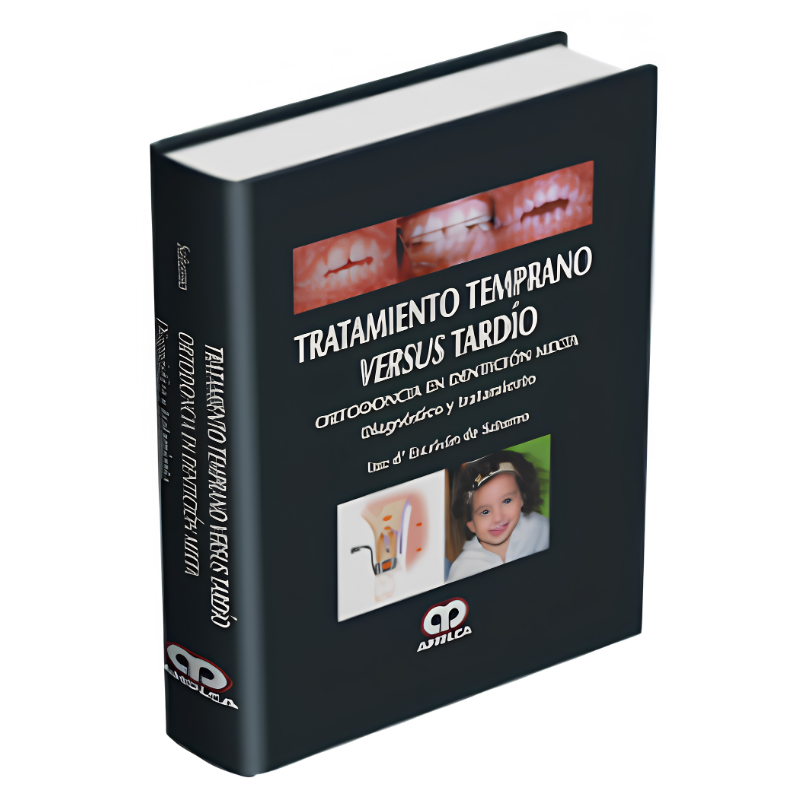

Autor: Luz d’Escriván de Saturno
Es motivo de satisfacción para el equipo de redactores del libro “ Tratamiento Temprano Versus Tardío – Ortodoncia en Dentición Mixta ”, el tener la oportunidad de realizar una revisión más exhaustiva de cada capitulo y tratado de actualizar y reforzar algunos conceptos a fin de llegar, lo más cercanamente posible, a un diagnóstico más acertado y con ello a un protocolo de tratamiento conducente a resultados más exitosos y estables.
Shipping From: Spain
De algo podemos estar en completo acuerdo, no sólo si se trata de problemas de la oclusión, sino incluso a nivel de la salud general del individuo: no podemos reconocer una situación anormal si no conocemos las condiciones de normalidad. Le atribuimos al hecho de que recientemente la estética dental y sus implicaciones psicosociales han recibido un interés creciente en las investigaciones ortodóncicas, de manera que posiblemente, desde la perspectiva del paciente, la motivación más importante para el tratamiento ortodóncico es la mejoría de su apariencia facial y la principal razón para que ocurra la búsqueda de tratamiento es la de minimizar el problema psicosocial relacionado con ella, llegando a confirmarse que es la decisión tomada, tanto por el paciente como por sus padres e incluso por el clínico tratante al atribuirle a ese aspecto mayor relevancia que a la salud dental propiamente.
Sección I.- (¿Qué está mal?) Principios y fundamentos
I.- Anatomía de los maxilares.
II.- Conceptos generales.
III.- Transición de la dentición primaria a la permanente.
IV.- Los arcos dentarios.
V.- El factor edad en el tratamiento de los problemas en la dentición mixta.
VI.- Factores que determinan la posición de los dientes dentro de los arcos dentarios.
Sección II.- Diagnóstico de los problemas ortodóncicos
VII.- Diagnóstico de problemas ortodóncicos. El examen del paciente. Los registros de diagnóstico.
VIII.- Etiopatogenia: factores generales.
IX.- Etiopatogenia: factores locales.
X.- Diagnóstico de problemas no esqueléticos en la dentición mixta: análisis de la discrepancia dentaria.
XI.- Diagnóstico de los problemas esqueléticos en la dentición mixta.
Sección III.- Biomecánica del movimiento dentario
XII.- Biomecánica del movimiento ortodóncico.
XIII.- Aparatos de anclaje extraoral: movimientos ortodóncicos y ortopédicos.
Sección IV.- Alternativas de tratamiento
XIV.- ¿Cuándo intervenir? Tratamiento temprano vs. tardío.
XV.- Tratamiento de problemas no esqueléticos: maloclusiones Clase I.
XVI.- Tratamiento de problemas no esqueléticos: maloclusiones Clase I.
Discrepancia longitud del arco/material dentario.
XVII.- Tratamiento de problemas esqueléticos: maloclusiones Clase II.
XVIII.- Tratamiento de problemas esqueléticos: maloclusiones Clase III.
XIX.- Tratamiento de problemas esqueléticos: mordidas abiertas.
Fenotipo hiperdivergente.

Data sheet
Specific References
Autor: Luz d’Escriván de Saturno
Es motivo de satisfacción para el equipo de redactores del libro “ Tratamiento Temprano Versus Tardío – Ortodoncia en Dentición Mixta ”, el tener la oportunidad de realizar una revisión más exhaustiva de cada capitulo y tratado de actualizar y reforzar algunos conceptos a fin de llegar, lo más cercanamente posible, a un diagnóstico más acertado y con ello a un protocolo de tratamiento conducente a resultados más exitosos y estables.