- New
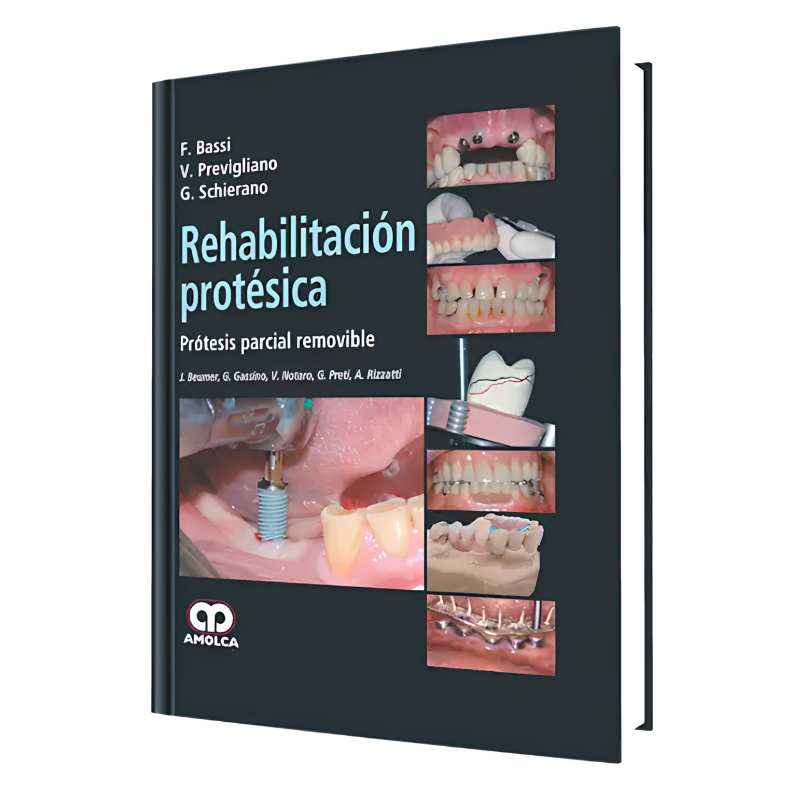

Author: Francesco Bassi
Partial edentulism represents and always represent, in adulthood, the oral situation that the rehabilitator should face. Total edentulism will tend to appear prevalently in the geriatric age. The arrival of implantology and its evolution with tilted zigomatic implants, mainly correlated with recent surgical regeneration techniques, grafts and bone distractions, have expanded the possibility of prosthetic treatment.
Shipping From: Spain
1.- Introduction.
2.- Fundamental aspects
Psychological aspect - Systemic aspect. Hygienic-periodontal aspect - Prosthetic appearance.
3.- Diagnosis
Mucosa - Alveolar crests - muscles - tongue. Residual denture - Classification of partial edentulism. Analytical guide of the treatment plan.
4.- Treatment plan
Analysis in the parallelometer - Guide plans - retentive areas. Interference structures - Aesthetic considerations. Tripodization of the models. Design of the prosthesis and functional selection of the components. Supports - Running support - Support types. Indirect retainers - types of indirect retainers. Hooks - Hooks function - Hooks requirements. Types of hooks - Greater connector - Types of larger connectors. Minor connectors - Classification of minor connectors. Preparation of oral cavity - surgical therapy. Periodontal therapy - Restorative therapy - Orthodontic therapy. Correction of the occlusal plane - Preparation of the teeth pillars. Realization of the guide plans - Realization of the support sites. Modification of Ecuador - Printing for the Master Model. Maxillary printing - Mandibular printing. Techniques to determine the depth of the floor of the mouth. Removal of the bucket and handling of printing. Determination of the functional morphology of the sublingual groove for the sublingual bar. Functional method - Mucostatic method - combined method. Printing for PPR with settings - laboratory phases. Preparation of the master model - Duplication of the model. Waxing the metal structure - casting of the metal structure. Finishing and polished of the metallic structure - rose and acrylated. Clinical adaptation of the metal structure. Physiological adjustment - Technique of the modified model (Altered Cast). The heading of the teeth in removable partial prosthesis. I Phase of chewing - Compensation of the inclined planes at the occlusal level. Compensation of the occlusal inclined planes in relation to the morphology of the alveolar crests - compensation of the occlusal planes inclined in relation to the incongruity of the ridges and contemporary respect of the neutral area - II phase of the Chewing - III Phase of chewing - The selection of material - Biomechanical construction principles of PPR toothucosorted. PPR with rotational insertion axes.
5.- Delivery - Adaptation
Marginal adaptation - Adaptation of the support surface. Muscular adaptation of the prosthesis - Occlusal control - POSENTREGE. Reactions after delivery - increase in salivation. Phonetic difficulty - Accidental bite - Trauma or compression injury. Instructions for the patient after delivery - insertion of the prosthesis. Removal of the prosthesis - cleaning and hygiene of the prosthesis. Hygiene of tongue and soft tissues - controls. Proposal of written instructions to deliver the rehabilitated patient with PPR. Follow-up - Physiological aging - Nutrition aspects. Systemic conditions - Follow-up of the PPR. Clinical and radiological assessment - Valuation of the prosthesis. Emergencies - Clinical case: Repass of the prosthesis. Clinical case: Relax of the support bed with resin composed on the control.
6.- Forecast
Psychological aspect - Dental and periodontal appearance - Prosthetic Appearance
7.- Precision settings in PPR
Classification of settings - Intraccoral adjustments Telescopic crowns - extracoronal adjustments. Adhesive settings - Root settings. Adaptation of bolts with direct technique. Adaptation of bolts with indirect technique. Bar Settings - Auxiliary Settings - Piston Settings. Screw anchors - Peri-Overdress (P-OVD). Clinical procedure
8.- PPR assisted by implants
Introduction - Therapeutic selection. Bone quantity and impossibility of making bone grafts. Intermaxillary relationships and support of the perioral soft tissues. Extensions - Phonetics / aesthetic - oral hygiene. Indications for the use of implants in PPR. Reduced salivary flux - neuromuscular control. Excessive Nauseous Reflection - Sicologic Factors. Maintenance of remnant dental structures. Removal of hooks for aesthetic purposes. Failures in implant fixed prosthesis. Kelly combined syndrome. Biomechanics of the removable partial prosthesis. Selection of position and implant in PPR. Types of anchoring in implants - Conclusions.
9.- Removable partial prosthesis for maxillary and mandibular defects
Introduction - Maxillary defects. PPR for total maxillary defects (maxosectomy). PPR For partial maxillary defects (Falacectomy). Mandibular defects. PPR with lateral discontinuity defect. PPR for defects with maintained or restored mandibular continuity.
Analytical Index - Main offices.

Data sheet
Specific References
Author: Francesco Bassi
Partial edentulism represents and always represent, in adulthood, the oral situation that the rehabilitator should face. Total edentulism will tend to appear prevalently in the geriatric age. The arrival of implantology and its evolution with tilted zigomatic implants, mainly correlated with recent surgical regeneration techniques, grafts and bone distractions, have expanded the possibility of prosthetic treatment.