- New
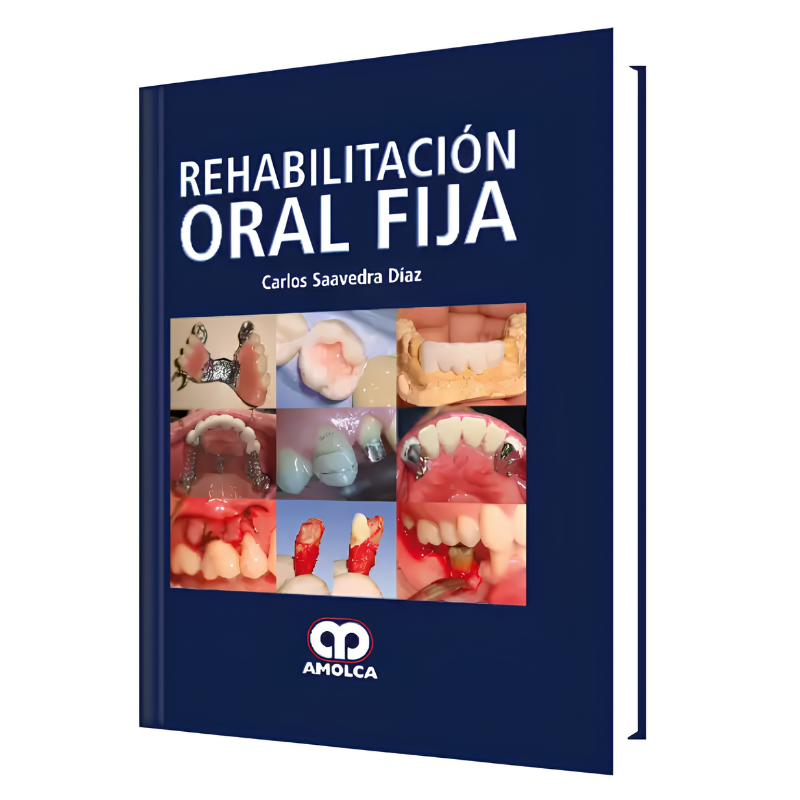

Author: Carlos Saavedra Díaz
The origin of this book dates back to the hours of practices of the oral rehabilitation course dictated. In general, when the classes were over, it felt that time was very short and it was necessary that our students had "notes" under the arm so they could then emphasize what was practiced.
Shipping From: Spain
We must consider that we at the university are framed in a learning teaching process that promotes and generates technical, technological and scientific knowledge and as any dynamic process that knowledge must be fluent. To ensure this fluency, this knowledge must be within a communication process with its own language, which must allow understanding and assimilation and subsequent processing to produce greater or better knowledge and then the cycle is repeated. Communicating and verifying knowledge is what allows us the easy understanding of what is said and does. In fixed prosthesis we also find the systematization of knowledge with its own language, and that it is verifiable, which will allow us to communicate and understand.
However, in a personal way I believe that this book is a significant product of three personal factors (or maybe needs):
1. The need for expression. Our very human nature makes each one of us try to express himself, and he wants, but time, family, work, among other things, are limiting for intellectual development, more sometimes you have to create a moment or several moments when we can sit down to write and Plasma our expression.
2. The possibility of improving communication in our course, as already said. While the course was very dynamic, since oral rehabilitation is very dynamic, you would always lack details that we try to insert them here. Compiled in graphics, figures and unpublished images try to explain the whole process that leads to perform a prosthetic crown. Step by step in a model is showing diagnostic planning, biomechanical preparation, provisionalization, etc., and also clinical cases following the same process since the patient reaches up to its definitive high.
3. There are also about 25 years of experience and having been walking through dentistry, modestly: "Looking at" and experiencing things. «What works and what does not work», or, rather, what works or what does not work for me. We could finally say that this book represents a summary of my own teaching-learning process.
All sequences of clinical cases correspond to my personal file, whose treatments have been made at the Dental Clinic that I run. The photographs that correspond to the section "what should not be done" were done in the course practices by the students. It has wanted to record the most common defects and from there generate a knowledge of what should not be done, since all the above ("the technique of carving and clinical case") suggests everything that should be done.
Chapter I.- Second Molar Superior.
Chapter II.- First Molar Superior.
Chapter III.- Premolar.
Chapter IV.- Canines.
Chapter V.- Incisivors.

Data sheet
Specific References
Author: Carlos Saavedra Díaz
The origin of this book dates back to the hours of practices of the oral rehabilitation course dictated. In general, when the classes were over, it felt that time was very short and it was necessary that our students had "notes" under the arm so they could then emphasize what was practiced.